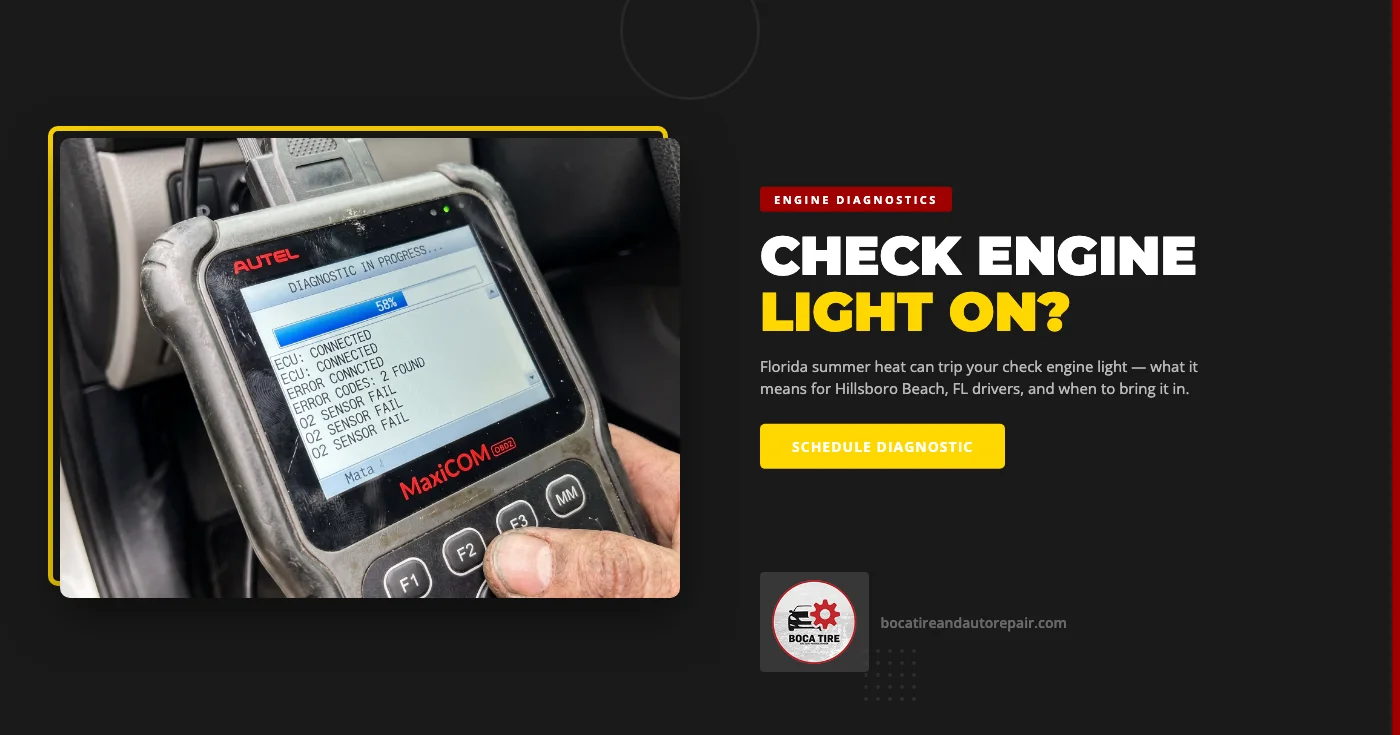
Every summer we get the same call from Hillsboro Beach, FL drivers: the check engine light popped on during a run down A1A, on the way home from errands, or a few minutes after starting the car in a hot driveway. Ambient temperatures in the low 90s, pavement well above that, humidity above 80% — South Florida summer is one of the harshest environments in the country for a modern engine, and the check engine light in Hillsboro Beach, FL is one of the most common warnings we diagnose from June through September.
The good news is that a check engine light is almost never an emergency the moment it appears. What matters is what the light is telling you, how it’s behaving, and how quickly you get a professional scan. Below, our ASE-certified team at Boca Tire and Auto walks through why Florida heat triggers the light so often, the causes we see most on Hillsboro Beach vehicles, and what a modern diagnostic actually involves.
Why Florida Summer Heat Triggers the Check Engine Light
Every modern vehicle sold in the United States since 1996 uses an On-Board Diagnostics II (OBD-II) system, a network of sensors that continuously monitors engine performance, emissions, and dozens of other parameters. When any of those readings falls outside the tolerance range programmed by the manufacturer, the engine control module (ECM) stores a diagnostic trouble code and turns on the check engine light. In a mild climate, those tolerances are easy to stay within. In Hillsboro Beach summer conditions, the margin shrinks fast.
Under-hood temperatures on a Florida afternoon can climb well past 200°F even at idle. Oxygen sensors, mass airflow sensors, and catalytic converters are engineered to work within specific heat ranges, and sustained exposure at the top of those ranges accelerates wear and produces erratic readings. On top of that, the coastal humidity along Hillsboro Beach pushes moisture into places manufacturers didn’t design for — connectors, seals, vapor lines — and salt air corrodes electrical grounds that a check engine light depends on being clean. The combination is why we see a summer spike in codes we rarely see in January.
Common Heat-Related Causes for Hillsboro Beach Vehicles
When a check engine light comes on during a Hillsboro Beach summer, the diagnostic codes cluster into a handful of common causes. These are the ones our ASE-certified technicians see most:
- Failing oxygen (O2) sensors. These sensors sit in the exhaust stream and get cooked every summer. When their readings drift, the ECM sees the wrong air/fuel ratio and lights the code. This is one of the most common summer triggers in our shop.
- Loose, damaged, or heat-warped gas caps. Rubber seals expand and contract in the heat. A cap that sealed fine in March may lose its vapor seal in July, which the OBD-II system flags as an evaporative emissions leak.
- Evaporative (EVAP) system leaks. Beyond the gas cap, cracked purge valves, degraded charcoal canister hoses, and pinhole leaks in fuel vapor lines all show up more often once temperatures spike.
- Cooling system stress. A weak thermostat, aging radiator, or clogged coolant passages that were adequate in mild weather can push engine coolant temperature above the ECM’s threshold and trigger a code, often paired with a rising temperature gauge.
- Battery and electrical faults. Florida heat is brutal on batteries. A weakening battery causes voltage dips that can throw ghost codes across multiple systems — a common source of “random” check engine lights in Hillsboro Beach summers.
- Mass airflow (MAF) sensor contamination. Humid coastal air combined with oil vapor coats the sensor element, distorting airflow readings and triggering lean or rich fuel codes.
Any one of these can turn on the light. Sometimes two or three overlap, which is why a code reader alone rarely tells the full story.
Steady vs. Flashing: What the Light Actually Means
Before you decide what to do next, look at how the check engine light is behaving. That single detail changes the urgency significantly.
A steady, solid check engine light means the ECM has stored one or more trouble codes but has not detected an active condition that could cause immediate damage. The vehicle is drivable in most cases. That doesn’t mean you can ignore it — a small issue caught this week almost always costs less than the same fault caught after another 2,000 miles — but you don’t have to pull over on Hillsboro Mile to call for help.
A flashing or blinking check engine light is a different situation entirely. It signals an active engine misfire severe enough to send unburned fuel into the catalytic converter. That raw fuel ignites inside the converter, and converter temperatures can climb high enough to melt the internal substrate in a matter of miles. Replacement catalytic converters routinely cost more than $1,500 — and often much more on newer vehicles — so a flashing light is one of the few dashboard warnings that genuinely justifies stopping as soon as you can pull off the road.
When to Pull Over vs. Keep Driving in Hillsboro Beach Heat
Because Florida summer conditions stack multiple stressors at once, the decision to drive or stop deserves a little more thought than in a milder climate. Use the following as a quick guide:
Pull over and shut the engine off as soon as reasonable if you see:
- A flashing check engine light
- The temperature gauge climbing into the red or the “hot” zone
- Steam or coolant smell from under the hood
- Any loss of power, hesitation, or heavy roughness under acceleration
- Burning smells, unusual noises, or oil-pressure warnings alongside the light
You can typically continue driving carefully to our shop if:
- The light is steady, not flashing
- The vehicle drives, shifts, and idles normally
- The temperature gauge sits in the normal range
- No other warning lights are illuminated
When you’re not sure, err toward getting off the road. Hillsboro Beach summer heat compounds every mechanical problem quickly, and a two-mile idle in slow A1A traffic on a 94-degree afternoon is far harder on a struggling engine than the same distance in October.
What Happens During a Modern Diagnostic Scan
A common misconception is that check engine diagnostics in Hillsboro Beach means plugging in a scan tool, reading a code, and swapping the part it names. Modern diagnostics is far more involved — and skipping the process is why so many drivers pay for repairs that never actually fix the issue.
When you bring a vehicle to our shop for a check engine light, our ASE-certified technicians follow this process:
- Pull all stored codes. We connect a professional-grade scan tool and retrieve every trouble code across every module — not just the powertrain code that lit the dashboard.
- Review freeze-frame data. The ECM stores a snapshot of engine conditions the moment the code triggered: coolant temp, RPM, speed, fuel trims. That data narrows down the cause dramatically.
- Run live data checks. With the engine running, we watch sensor outputs in real time to see which readings are drifting or spiking.
- Perform targeted tests. Depending on the code, that might mean a smoke test for EVAP leaks, a compression check, an injector balance test, a fuel pressure test, or a component-specific voltage check.
- Confirm the actual cause before recommending any repair. The code is a starting point, not a diagnosis. We tell you what we found, what needs to happen, and what it will cost — in writing — before any parts are ordered.
You can learn more about our full engine diagnostics process and the equipment we use on our services page.
Preventive Steps to Avoid Summer Breakdowns
The best check engine light is the one that never comes on. A handful of preventive steps carry outsized weight in the Hillsboro Beach climate:
- Have your battery load-tested every spring. Florida heat is the top killer of car batteries. Catching a weak battery before summer prevents no-start situations and the ghost codes a dying battery throws.
- Flush your cooling system on the manufacturer’s schedule. Old coolant loses its corrosion inhibitors and heat-transfer performance. Our cooling system service restores both.
- Replace the gas cap if it clicks less than three times when tightening. A worn cap is a $20 fix that prevents an EVAP code and an unnecessary diagnostic visit.
- Clean or replace the mass airflow sensor at recommended intervals. A quick preventive step that heads off a common summer code.
- Change engine oil on time. Old oil breaks down faster in high heat, and clean oil is essential for the variable valve timing and turbo components modern engines depend on.
- Watch fluid levels weekly. Coolant, oil, and even brake fluid all evaporate slightly faster in Florida heat. A five-second dipstick check catches a lot of trouble early.
None of these prevent every check engine light, but together they eliminate the vast majority of preventable summer codes we see.
Why Local ASE-Certified Diagnostics Matter for Hillsboro Beach Drivers
Chain quick-lube shops and generic code-reader kiosks have their place, but a check engine light in Hillsboro Beach summer heat deserves a real diagnosis from a local shop that understands the environment. Our ASE-certified technicians at Boca Tire and Auto have spent more than 20 years diagnosing Florida-specific failures — the corrosion coastal air produces, the EVAP failures that peak in July, the cooling weaknesses that snowbird cars develop in humid garages, and the electrical gremlins that show up only after a wet afternoon.
Just as important, our team gives you a straight answer: an itemized estimate, a plain-English explanation of what the code means, and a repair only when your vehicle actually needs one.
Frequently Asked Questions About the Check Engine Light in Hillsboro Beach, FL
Why does my check engine light come on in Florida heat?
Extreme heat, coastal humidity, and salt air push sensors and emissions components past their designed tolerances. Oxygen sensors, EVAP components, gas cap seals, and weakening batteries are the most common summer triggers we see in our Hillsboro Beach diagnostics work. Every code deserves a scan to know whether it’s a real fault or a heat-induced glitch.
Can I drive with a check engine light on in Hillsboro Beach, FL?
If the light is steady and the vehicle drives, idles, and shifts normally with no other warning lights, you can generally continue driving carefully to our shop for a diagnostic. If the light is flashing, or if you notice loss of power, unusual noises, a climbing temperature gauge, or burning smells, pull over and shut the engine off as soon as reasonable. Flashing lights typically mean an active misfire that can quickly ruin the catalytic converter.
What causes the check engine light in summer Florida?
The top summer causes we diagnose are failing oxygen sensors, loose or degraded gas caps, EVAP leaks, weak batteries throwing voltage dips, cooling system faults, and contaminated mass airflow sensors. Heat and humidity accelerate wear on each system, which is why the light comes on more often between June and September than in the cooler months.
Where can I get check engine diagnostics near Hillsboro Beach, FL?
Our shop is a short drive from Hillsboro Beach and serves east Broward and south Palm Beach, including Deerfield Beach, Pompano Beach, Delray Beach, and Boca Raton. We offer full check engine diagnostics with ASE-certified technicians, professional-grade scan tools, and written estimates before any work begins.
Schedule Your Check Engine Diagnostic With Boca Tire and Auto
If your check engine light is on and you’re somewhere between the Intracoastal and A1A, don’t wait it out. Bring the vehicle in, let our ASE-certified team pull the codes, run the tests, and give you a clear answer. Boca Tire and Auto serves Hillsboro Beach, Deerfield Beach, Delray Beach, Boca Raton, Pompano Beach, and Fort Lauderdale drivers with full-service check engine repair and competitive pricing on professional engine diagnostics. We’ll tell you what your vehicle needs, what it doesn’t, and what it will cost before we touch a wrench.