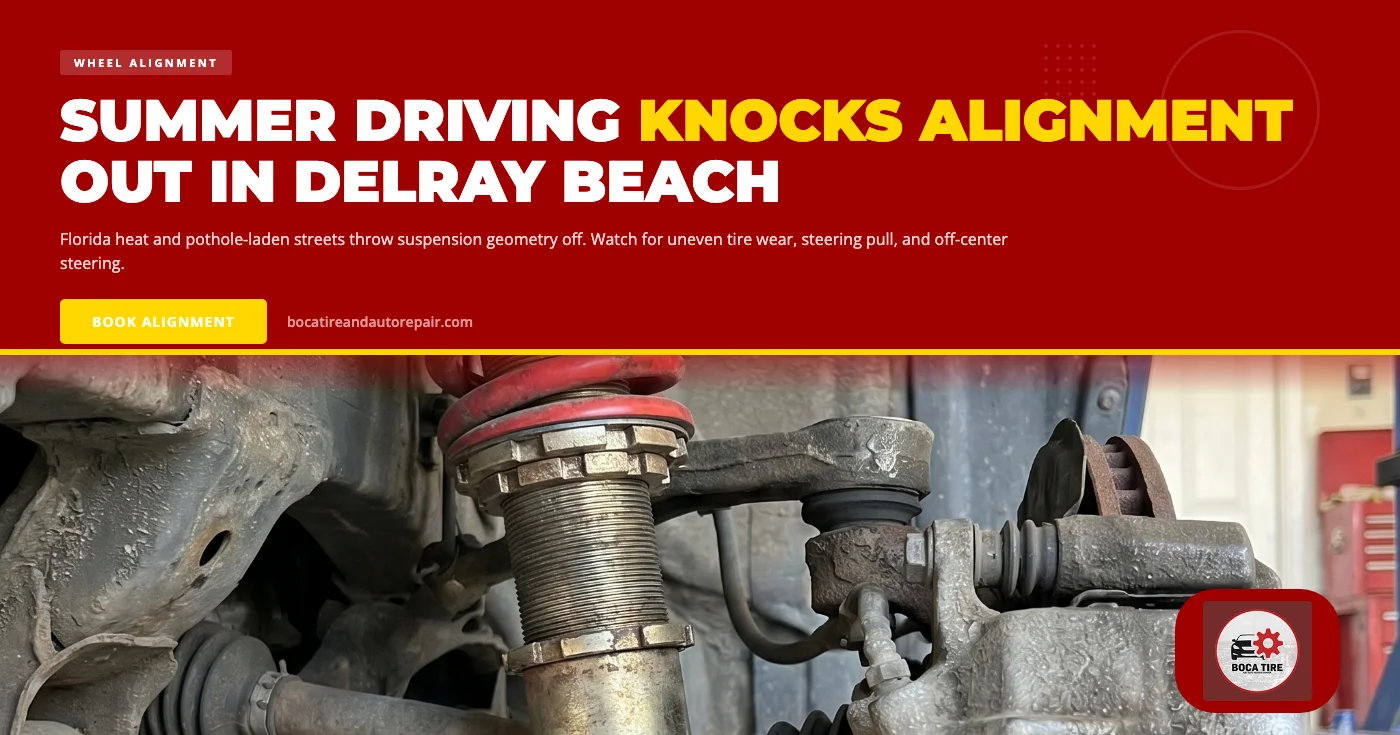
If your steering wheel has started tugging to one side on Atlantic Avenue, or a set of tires you bought last winter is already showing bald spots on the edges, Florida’s summer is likely the reason. Between heat cooking suspension bushings, active resurfacing on A1A, and the miles families put on from June through August, we see more misaligned vehicles roll through our bays in late summer than any other stretch of the year. If you’re searching for a wheel alignment in Delray Beach, FL right now, you’re in good company.
Below, our ASE-certified team walks through how South Florida summer knocks alignment out of spec, the warning signs Delray drivers should watch for, why the tail end of summer is the right window to correct it, and how alignment differs from balancing — a question we field almost every week.
How South Florida Roads and Summer Heat Affect Your Wheel Alignment
Most drivers picture alignment problems as one dramatic event — a curb clip in a downtown Delray parking garage, or a jarring pothole on the way home. Those absolutely do it. But in South Florida, summer heat is the slower, quieter culprit that pulls more vehicles out of spec than any single impact.
Your suspension geometry depends on dozens of rubber and polyurethane bushings, ball joints, and tie rod ends holding everything in precise position. When Delray Beach asphalt hits 140°F in the middle of a July afternoon, that rubber gets cooked. Combined with the salt-heavy Atlantic air east of Federal Highway, bushings soften, crack, and slowly deform. The result is tiny shifts in camber, caster, and toe angles you won’t see in the driveway — but your tires will feel every one.
Delray’s road network makes it worse. The A1A / South Ocean Boulevard stretch between Linton Boulevard and Atlantic Avenue is in the middle of a Florida DOT milling and resurfacing project running through fall 2026, so you’re driving over pavement transitions and lane shifts almost daily. Add the I-95 resurfacing work, pothole patches along Congress Avenue after every heavy summer storm, and the deep expansion joints on older sections of Federal Highway, and you have a recipe for alignment drift that quietly builds all summer.
Top Warning Signs Your Alignment Is Off in Delray Beach Driving Conditions
Alignment rarely fails all at once. It creeps — and if you know what to feel for, you can catch it long before it costs you a set of tires. Here are the signs we ask Delray Beach drivers to watch for:
- Steering pull on a straight, flat road. Loosen your grip briefly on a level stretch of Atlantic Avenue west of Military Trail. A gentle drift can be road crown; a firm, consistent pull to one side is almost always alignment.
- Off-center steering wheel. If the car goes straight but the wheel is cocked to the left or right, toe is out of spec — often after a curb strike or a hard pothole hit.
- Uneven tire wear. Run your hand across the tread. If one edge is smooth and the other still has grip, camber or toe is off. “Feathering,” where the tread feels like little ramps, is another giveaway.
- Squealing tires in easy turns. Aligned tires roll through corners. Misaligned tires scrub across the pavement, and you’ll hear it on the on-ramp to I-95 or turning onto Linton from Federal.
- A wandering, loose steering feel. If the car hunts around in its lane instead of tracking straight, that’s usually alignment drift compounded by worn suspension components.
- Steering wheel vibration at highway speed. Sometimes balance, sometimes alignment, often both — and worth a proper check either way.
Two or more of these showing up together in August is the moment to book a car alignment service in Delray Beach, Florida instead of waiting for the next tire rotation.
How Summer Road Trips Make Alignment Problems Worse
Summer is when most Delray families put on real miles — runs up the Turnpike, long weekends to Orlando, trips into the Panhandle. Every one compounds a marginal alignment problem instead of hiding it.
Long runs at 70 mph do more than accumulate wear. A tire toed out by even a fraction of a degree is dragged sideways the entire drive, spiking tread temperature. Add a fully loaded vehicle — luggage, coolers, bikes on a rack — and the extra weight lowers ride height slightly, which shifts alignment angles further out of spec. Unfamiliar interstate potholes and construction transitions finish the job.
Many drivers roll back into Delray in August with a set of tires that were fine in May and are now feathering on the inner edges. If you’ve just come off a long summer trip, a quick wheel alignment check before you settle back into fall commuting is one of the smallest maintenance costs you can spend to protect the tires still on your car.
What Happens to Your Tires When You Drive on Misaligned Wheels
Ignoring alignment isn’t just a comfort issue — it’s where a full set of tires quietly gets used up. Here’s what we see happen in vehicles that come in months after the first warning sign:
Tire life drops sharply. A premium set rated for 60,000 miles can be finished in under 25,000 when they’re scrubbing sideways down every road. We regularly see nearly-new tires with irreversible camber wear on the inside edge, invisible from a walk-around and only obvious once the wheels come off.
Fuel economy takes a hit. The U.S. Department of Energy notes that improperly maintained tires — underinflated or misaligned — can measurably reduce fuel economy. With a summer of stop-and-go on Federal Highway and I-95, that adds up to real dollars over a season.
Handling and wet-weather grip get worse. Delray’s afternoon downpours turn Congress Avenue and A1A into standing water in minutes. Misaligned tires hydroplane sooner and recover more slowly because the contact patch isn’t sitting square on the road.
Blowout risk rises in peak heat. NHTSA data shows tire-related crashes climb sharply from May through October, when heat, highway speeds, and overheated tread stack together. A tire dragging on one edge all summer runs hotter than the rest of the set — and that’s the one that fails on I-95 in August.
Wheel Alignment vs. Wheel Balancing: What Delray Beach Drivers Need to Know
These two services get used interchangeably at the counter, but they solve completely different problems.
Wheel alignment is about geometry — the angles at which each tire meets the road. The three key angles are camber (how far the tire tilts in or out from vertical), caster (the steering axis angle), and toe (whether the tires point dead straight or slightly in or out). On our alignment rack, our technicians use laser sensors and precision targets to bring all four wheels back to factory spec.
Wheel balancing is about weight distribution inside each tire-and-wheel assembly. Small variances in tire and rim weight cause vibrations at highway speed. We spin each assembly on a balancer and add small counterweights to the rim until the wheel spins true. Balancing happens any time tires are mounted, rotated, or repaired.
Why the distinction matters: a vibration that shows up at 65 mph on I-95 is usually a balance problem, while a pull on a flat road is alignment. Uneven wear can be either. When Delray drivers come in for tire rotation or new rubber, we check both — because paying for new tires on a misaligned or unbalanced vehicle is money set on fire before you leave the parking lot.
How Often Should Florida Drivers Get a Wheel Alignment?
Most manufacturers recommend an alignment check every 6,000 to 10,000 miles or roughly once a year for the average driver. For Delray Beach drivers, we lean toward the more frequent end of that range for reasons specific to our climate and roads.
First, summer heat softens suspension bushings faster here than in cooler markets. Second, the mix of active construction on A1A and I-95, weather-blown potholes, and coastal drainage grates guarantees you’ll take a hit or two you didn’t plan for. Third, plenty of vehicles in Delray are late-model European sedans and performance SUVs with low-profile tires and stiff suspensions — both of which show alignment drift faster and pay the bigger price in tire wear.
Our practical guidance for most Delray drivers:
- A four-wheel alignment check every 12 months, regardless of mileage.
- Immediately after any hard pothole, curb clip, or sudden impact.
- Every time you install a new set of tires — there’s no worse way to waste new rubber.
- After any suspension work — struts, control arms, tie rod ends, ball joints.
- Anytime you notice one of the warning signs above.
For drivers who commute daily up to West Palm or down to Fort Lauderdale, a check every six months is well worth the small cost.
Why End-of-Summer Is the Right Time to Get Your Alignment Checked
By late August, your vehicle has absorbed the worst of what South Florida can throw at it — peak heat, peak humidity, and a full calendar of summer trip miles. That’s why the tail end of summer is the ideal window for alignment repair near Delray Beach.
Catching a small toe or camber drift now protects the tires you already own before the wear pattern becomes permanent. It also sets you up for the fall — snowbird traffic ramps up in October, storm-related pavement damage keeps arriving through the season, and a vehicle tracking straight when the roads start filling back up handles better and stops shorter. An end-of-summer alignment is one of the highest-return, lowest-cost maintenance items on any Delray driver’s calendar.
Frequently Asked Questions About Wheel Alignment in Delray Beach, FL
How long does a wheel alignment take?
A standard four-wheel alignment on most vehicles takes 60 to 90 minutes once we’re on the rack. If our inspection turns up a worn tie rod end, ball joint, or bushing that needs replacement before we can hold the settings, we’ll walk you through the fix and the added time before starting.
Do I need a two-wheel or four-wheel alignment?
Nearly every modern vehicle on Delray roads needs a four-wheel alignment. Even many front-wheel-drive cars have adjustable rear suspensions, and setting only the front angles on those vehicles leaves the geometry incomplete. We inspect and confirm before starting.
Will an alignment fix uneven tire wear?
It will stop new wear from developing, but it won’t undo the pattern already there. Once a tire has scrubbed itself unevenly, that wear stays. The point of a timely alignment is to prevent the damage, not repair it — another reason to catch problems early.
Can Florida heat really throw alignment off by itself?
Yes, especially on vehicles with older suspension bushings. Heat doesn’t knock geometry out instantly, but repeated cycles of extreme temperature soften rubber components that then deform under normal driving loads. Layered on top of Delray’s road conditions, the drift compounds all summer.
How much does an alignment cost in Delray Beach?
Pricing depends on the vehicle and whether any related suspension work is needed. We give a clear, written estimate before any work begins, so there are no surprises when you pick the car up.
Schedule Your Wheel Alignment With Boca Tire and Auto
South Florida’s summer isn’t going to ease up on your suspension, but a quick check now protects your tires, your fuel bill, and the way your car handles in an August thunderstorm. Whether you’ve noticed a pull, spotted uneven tread wear, or simply want everything checked before fall commuting picks back up, our ASE-certified team is ready. Boca Tire and Auto serves Boca Raton, Delray Beach, Deerfield Beach, Pompano Beach, and Fort Lauderdale drivers with competitive pricing and complete wheel alignment service. We’ll tell you what your vehicle needs, what it doesn’t, and what it will cost before we touch a wrench.